
Cleaning, Disinfecting and Sanitizing Are Three Different Jobs
Read enough cleaning proposals and you will find the three words used interchangeably, sometimes in the same sentence. That is not a vocabulary problem. It is the reason two vendors can quote the same building, promise the same thing in writing, and deliver work that is not comparable.
What each one actually does
Cleaning removes. Soil, dust, residue, the film that builds up on a surface. It is mechanical — a cloth, a solution, friction. Nothing about cleaning claims to kill anything, and it does not need to in order to be the most important step.
Sanitizing reduces. It lowers the number of microorganisms on a surface to a level considered safe for that setting. Which level, and safe for what, depends on the standard being applied: a food-contact counter and a locker room bench are not held to the same one.
Disinfecting kills specified organisms on a hard surface — the ones named on the product’s label, under the conditions printed on that label. Outside those conditions, the claim on the bottle does not transfer to your building.
The order is not optional
Disinfectant applied to a dirty surface is largely wasted. Soil and residue shield what sits underneath, and many active ingredients are weakened by organic matter before they reach it. The sequence is clean first, then disinfect — two passes, not one.
Which means a schedule that budgets time for a single pass has quietly bought the first without the second. This is the most common place where a specification and a building diverge, and nobody ever decides to skip it. The time allocation decides for them.
What this means for what you sign
A line that reads “all surfaces sanitized daily” has not promised anything you could check. Three questions turn it into something real:
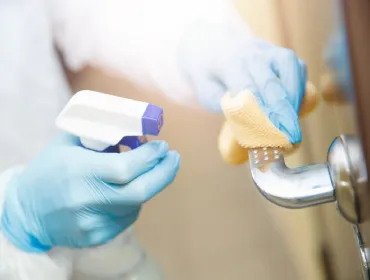
- Which surfaces? High-touch points are a short, specific list — handles, switches, rails, shared equipment, the things hands actually land on. That list is not the same as “all surfaces,” and pretending otherwise makes both of them meaningless.
- With what, and for how long? The product and its contact time, because the claim depends entirely on them.
- How is it evidenced? Not one signature at the end of a shift. Per-area records, with times on them.
A proposal that cannot answer those three is using the words as decoration.
Where we put the line
We list disinfection and high-touch cleaning as separate services on purpose. They are separately scheduled work with separate requirements, and folding them into a general janitorial line is how they stop happening without anyone noticing.
And what was done is recorded per area rather than per visit — see proof of service. “The building was sanitized” is a sentence. A room with a time on it is a record.